Ecological modeling
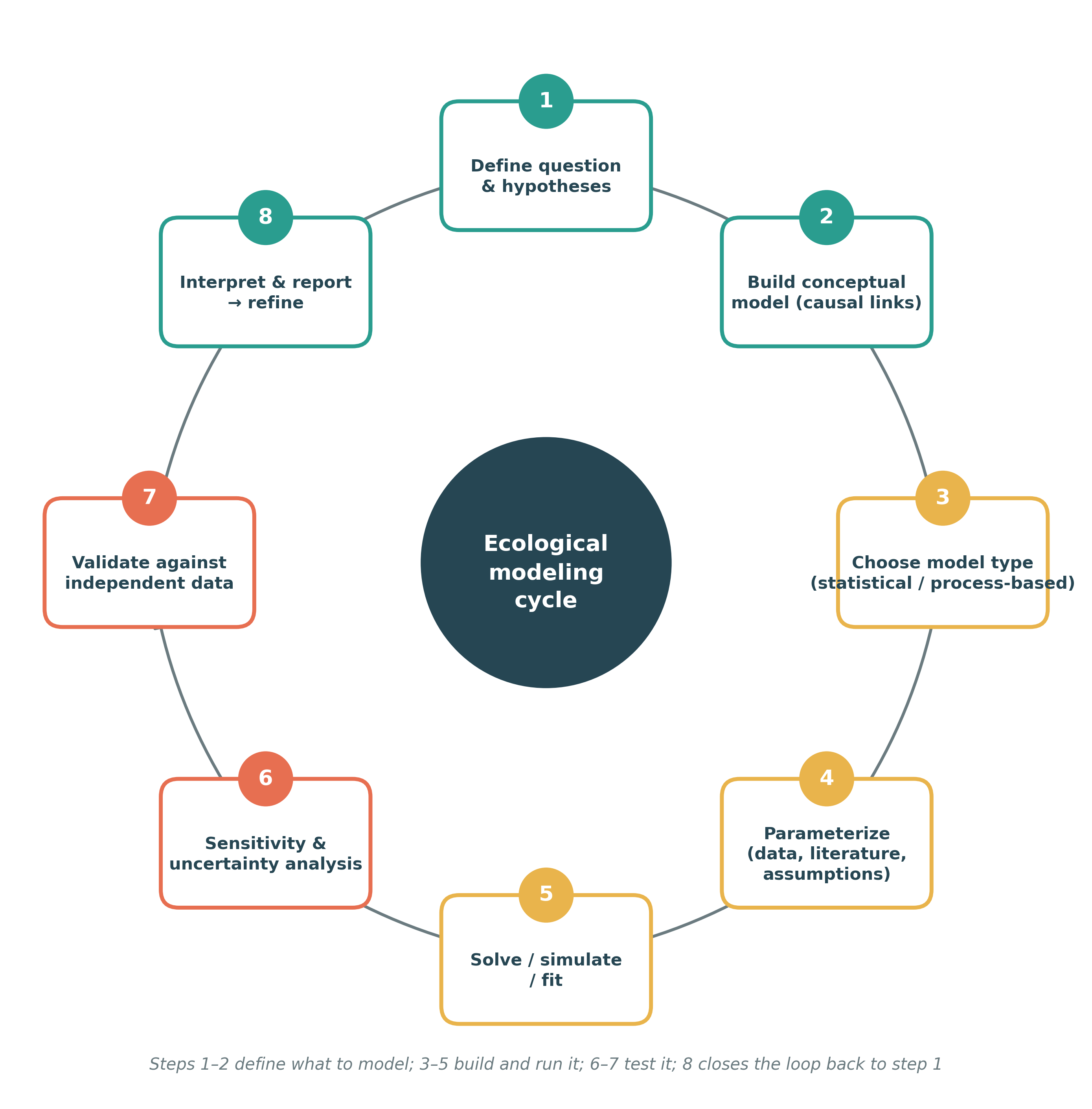
Ecological modeling provides a quantitative framework for understanding how organisms, communities, and ecosystems respond to environmental conditions and ecological processes.
Example 1: Species distribution model
Species distribution modeling (SDM) is a quantitative approach for understanding and predicting where species may occur based on their relationship with environmental conditions. It is widely used in ecology, biogeography, biodiversity conservation, climate-change research, and the study of invasive species.
Example 2: Community assembly processes
Community assembly models can be used to investigate how environmental filtering, competition, dispersal, and stochastic processes determine species composition along environmental gradients.
Common approaches include:
- Trait-based models
- Joint species distribution models
- Generalized dissimilarity models
- Null models
- Structural equation models
- Multivariate ordination and constrained ordination
- Spatial models
These approaches allow ecological observations to be linked to hypotheses about the mechanisms driving community composition.